Market Recovery Program
 

It's legal, it works, and it's guaranteed!

Home

Table of contents

Your Personal Assessment

Buy the book

Contact

About the author


Chapter 9

A REVOLUTION IN RETIREMENT PLANNING:
THE INCOME RIDER

What is a “rider”?

It is an attachment to an investment offered by insurance companies that provides additional conditions or benefits to the investment. In this case it is a rider attached to an indexed annuity, the investment that was the subject of the previous chapter.

And what is that additional benefit or condition available through this Income Rider that attaches to the indexed annuity?

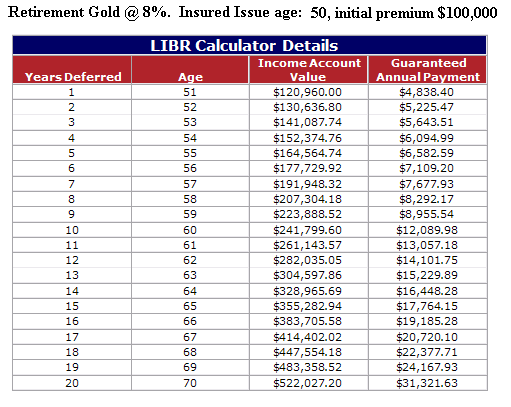
For the purpose of income and income only, the funds that you transfer into the indexed annuity are guaranteed to accumulate in the Income Rider account at 8% annual compound interest.[1] However -- again -- those funds are only available as income and can only be withdrawn according to a set schedule of future payments.


Figure 11


What exactly is the set schedule of future payments?

Figure 11 is an example of that all-important schedule.[2] This “LIBR Calculator Details” schedule is drawn up for a 50-year-old -- like Joe -- and is based upon a transfer of $100,000 from a 401(k) into the Indexed Annuity.

Let’s briefly go over each of the headings of the four columns of the schedule.

The first column, “Years deferred”, lists the years; the schedule spans year 1 to year 20.

The second column, “Age”, lists Joe’s ages that correspond to each of the years of the first column: Joe is 50 years old when he starts the program; 51 at the end of year 1 and 70 in year 20.

The third column, the “Income Account Value”, tells us how much Joe’s $100,000 has accumulated to each year. In year 10, there is $241,799.60; in year 20, $522,027.20.

The fourth column is the most important: “The Guaranteed Annual Payment”. Between the end of the first year and the end of the 20th year, Joe can turn on the annual income stream.[3] Once he turns it on, the amount on the schedule that corresponds to that year is the amount he will receive not only that year but each year for the rest of his life, no matter how long he lives.

Looking down the numbers in the fourth column it appears that the longer Joe waits to turn the income stream on, the more that the annual payment will be.

Correct.

For example, if Joe decides to turn the income stream on at the end of the first year when he‘s 51, the payout amount is relatively small: $4,838.40. [4]
However, if Joe waits until he’s 60, much more will have accumulated in the income account and he’ll get almost $12,089.98 a year.

At $12,089.98 a year, it will take Joe only 9 years -- when he’ll be 69 -- to break-even and get back his $100,000.

But if he waits longer -- and remember that his original plan was to wait until he reached age 70 -- he’ll have over $522,000 in the income account and his Guaranteed Annual Payment will be $31,321.63 a year… that works out to be a little over 3 years to break even on the $100,000. So all he has to do is live to be 73 and he’s got his original $100,000 back. See that?

Yes. But Joe isn’t looking to just “breakeven.” Joe did this program to get back to the pre-downturn $400,000.


By the time Joe is 83 years old -- 13 years after he starts receiving annual payments at age 70 -- he’ll have received over $400,000. If Joe lives another 7 years, he’ll receive an additional $219,251.41.

What are the chances Joe will live that long?

Did you know that more than 77% of all 50-year-old men will live to see their 70th birthday? And it‘s even higher for women: 85%. Furthermore, more than half of all 70-year-old men will go on to live to be 83; women, 63%. See Figure 12.

And those are today’s statistics. Improvements in medical technology are continually extending longevity and as a result life expectancy figures are continually being revised upwards…so these numbers will probably improve over time.


Figure 12


What if Joe dies at, say, age 71, one year after turning on the income stream?

If he’s married -- and this rule only applies to spouses -- and his wife is his beneficiary, then she continues to draw an annual income from the Income Account Value until the $512,000 is depleted or she dies.[5]

I’ve come to a tentative conclusion.

What’s that?

…that Joe very well may have accomplished his goal

I agree.

But why don’t we look at this question in more detail…


[1]  8% is available as of this writing. Note also that other products may offer different rates on their income riders.

[2] This product includes a 12% bonus that is reflected in the schedule. Keen observers will note that this is responsible for the disparity between the numbers in the schedule and the compound Interest rate charts.

[3] Note: with this product, the annuitant must be at least 50 years old before Guaranteed Annual Payments are available.

[4] Note that distributions prior to age 59 ½ may trigger a 10% penalty for early withdrawal.

[5] The remaining Income Account Value will continue to be distributed in a series of annual payments of up to 6% of the account’s value, based on the surviving spouse’s age at the date of the step-in, until the balance is depleted. See: Appendix C -- Guaranteed Income percentages.


BACK TO TABLE OF CONTENTS                        NEXT CHAPTER


---