An “annuitant” is the person designated on an annuity contract to receive the
benefits of the annuity while they are alive. An annuitant can be a single
person or two people. Joint annuitants are two annuitants designated on an
annuity contract.
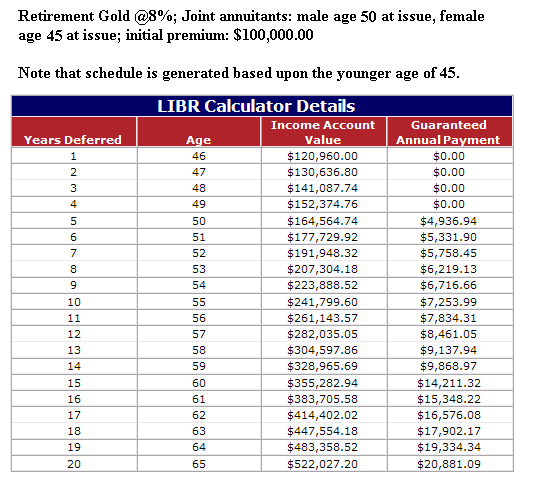
Figure 13
If there are joint annuitants under the Income Rider, the payouts under the
Guaranteed Annual Payment schedule appear to be markedly different than if there
was just one annuitant.
Yes. Payouts for two annuitants under the schedule will always be less than if
there was only one annuitant.
Compare the schedule for joint annuitants in Figure 13 with Figure 11 for a
single annuitant in the chapter in which the schedule was first introduced.
There is the same initial premium in both schedules and the same age for one of
the annuitants (age 50). However, in the schedule in Figure 13 we’ve added the
second annuitant, age 45. Note that the schedule is based upon and calculated on
the younger age.
The payouts under the schedule in Figure 13 are less than for the ones under
Figure 11.
If you think about it for a minute, it makes sense why that is. Two annuitants
have a greater chance of living a longer amount of time than just one. This is
even more true if the added annuitant is younger, which is the case here. This
means that there is a greater chance that the insurance company is going to end
up making more lifetime payouts than if there were just one 50-year-old
annuitant. As such, this greater liability is neutralized by a lower Guaranteed
Annual Payment amount for joint annuitants.
From our previous discussions in this section, we saw that Mary as Joe’s
spouse is nevertheless going to benefit if Joe is the sole annuitant: either
from Joe’s payout schedule if he‘s already started it at the time of his death
and he hasn‘t used up all the funds in the Income Account or if he hasn‘t turned
on the income stream at the time of his death. The question begs to be asked: which option is better for Joe and his wife: as
joint annuitants -- in which the payments are lower but are guaranteed to
continue until the second dies -- or just designating Joe as the annuitant -- in
which case the payments are higher but provide for a finite amount for the
survivor?
There are advantages and disadvantages to both courses of action, although you
must keep in mind that the decision to designate one or two annuitants can only
be made at the time the annuity contract is taken out and, once made, is
irrevocable.
For example, if Mary does not have longevity in her family history, it may be
opportune to have just Joe as the sole annuitant. However, if it is the reverse
and Joe comes from a history of premature death, it may be best to have both as
annuitants.
Here’s something to think about: Joe and Mary decide to make Joe the sole
annuitant. Joe subsequently lives a long life which may mean that at the time of
his death, all the funds in the Indexed Account had been exhausted through many
years of payments. If Mary survives him -- and she was counting on those
payments to maintain her lifestyle -- it may be a disappointment to discover
that there are no funds left to distribute to her.
Death is by definition unpredictable and, as such, can impact whatever decision
is made in ways that are unforeseen and undesirable. However, one should be
aware of the advantages and disadvantages of both courses of action so that one
can make the best informed decision possible.